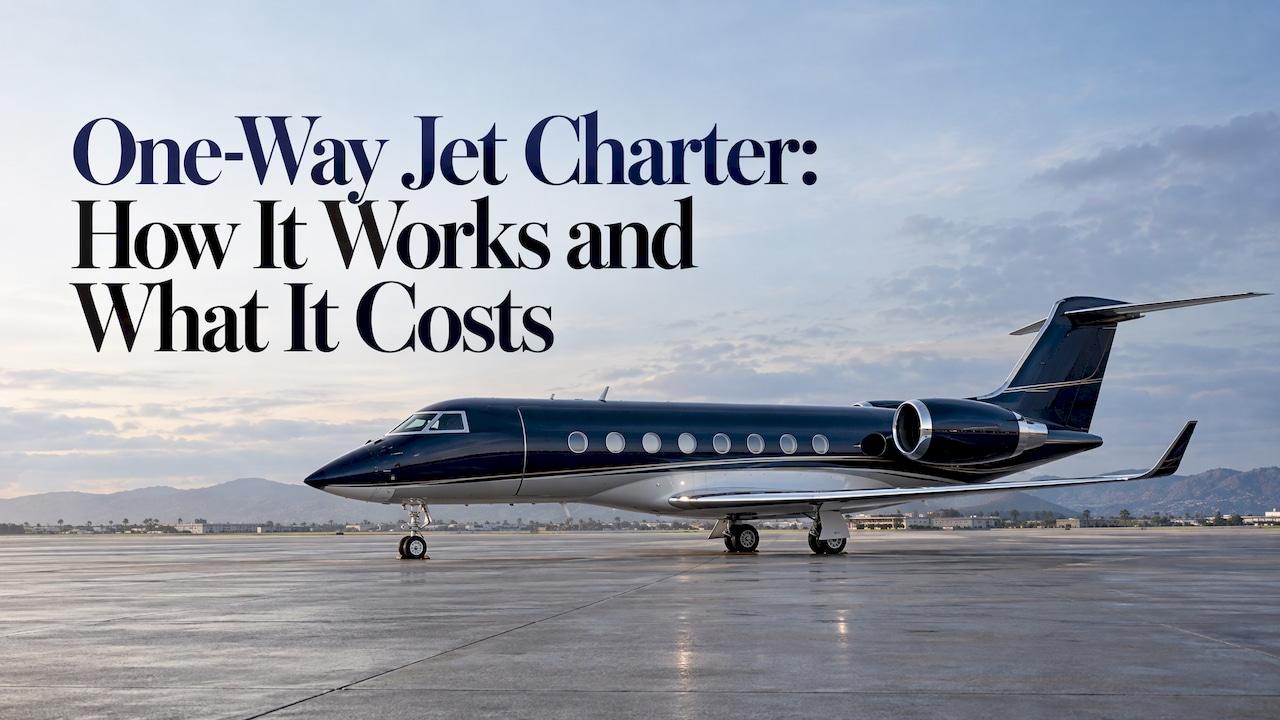
A one-way jet charter is a private aircraft booked for a single trip from point A to point B, with no return leg attached. You contract for the whole aircraft, you set the departure time and airports, and the price reflects the aircraft's movements, not just the hours you sit in the cabin. That is why a one-way flight is rarely exactly half of a round trip, and why the way it is sourced matters. At Avant Charter, a dedicated advisor manages each flight and sources the aircraft from a vetted worldwide network, including one-way, last-minute and empty-leg options.
TL;DR
- A one-way charter books the whole aircraft for one trip. You choose the departure time and airports, and a broker matches you with an FAA-certificated carrier.
- Price follows aircraft movements. A one-way trip can cost more than half of a round trip, or much less if the jet is already headed your way.
- Empty legs can lower the cost when your route and dates fit a repositioning aircraft, but they run on the operator's schedule, so keep a backup plan.
- Before you book, confirm which carrier operates the flight and that it holds the right FAA certificate. Ask for a quote that shows federal excise tax.
- Round trips make sense when you return within a few days to the same airport. One-ways suit open-ended, multi-city and last-minute travel.
Table of Contents
- What a one-way jet charter is
- Who actually flies the plane
- How one-way charter pricing works
- One-way or round trip: how to decide
- Empty legs: the lowest-cost way to fly one way
- What to check before you book any one-way charter
- One-way charter for your kind of trip
- How to book a one-way charter, step by step
- Arrange your one-way flight with Avant Charter
- Planning tips that keep one-way costs sensible
- FAQ
- Sources
What a one-way jet charter is
On a scheduled airline you buy a seat on a plane that flies whether you are aboard or not. A private charter works the other way around. You contract for the aircraft, and it flies when and where you say. The industry's trade body, NBAA, describes on-demand charter as flying in which the departure time, departure location and arrival location are specifically negotiated with the customer.
A one-way charter simply stops there. You fly from, say, Teterboro to Palm Beach, and the booking ends on landing. You do not need to plan the return, hold the aircraft for days, or pay for it to wait.
This fits several kinds of travelers:
- Corporate travelers whose meeting schedule is not fixed and who may end up flying home from a different city.
- Event planners moving a team to a venue on one day and handling the departure separately, or by a different route.
- Pet owners who want a pet in the cabin on a single relocation or vacation trip.
- Last-minute travelers who need to leave within hours and decide the return later.
Who actually flies the plane
This is the part new charter customers most often miss. A broker arranges your trip. A separate company operates it.
NBAA's broker guidance says a broker generally matches the customer's requirements with an FAA-certificated Part 135 charter carrier, and that the customer should be told which direct air carrier will operate the flight. Part 135 is the FAA rule set for commuter and on-demand operations. The General Services Administration, which buys charter for federal agencies, notes in its air charter brokers schedule that Part 135 operators must meet operating requirements, including flight-time and rest provisions for crews.
Avant Charter works as a charter broker: it arranges private aircraft through third-party operators, with a global network and a vetting process described on its charter safety and operator vetting page. For you, that means one point of contact for the whole trip while the operating carrier holds the certificate and flies the aircraft.
How one-way charter pricing works
The most common surprise in charter is that two one-way flights can cost more than one round trip, and that one one-way flight can cost more than half of a round trip. The reason is simple. Operators price the aircraft's movements, not only the time you are on board.
Consider three situations.
The jet has to come to you and go home empty
A charter aircraft is based somewhere. If you ask for a one-way trip from an airport where no suitable jet is parked, the operator must fly one in. If it must also fly back empty after dropping you off, both of those unoccupied flights are part of the cost to the operator. On a round trip with a short stay, the same aircraft carries you out and back, and those empty legs mostly disappear.

This is why a short round trip can look cheap per mile compared with a pair of one-ways.
The jet is already heading your way
The reverse also happens. An aircraft that has just dropped off a client in Aspen may need to return to Denver. A trip that matches that move uses a flight the operator has to make anyway. These are empty legs, and they are the clearest example of why one-way pricing can be low. We cover them below.
Waiting time and overnight stays
A round trip with a night or more at the destination adds crew costs for the stay, and the operator may charge for waiting time. A one-way trip has none of that. If your plans at the destination are open-ended, a one-way booking removes the guesswork about how long the aircraft should wait.
What also changes the number
| Factor | How it moves a one-way price |
|---|---|
| Distance and flight time | More hours in the air means a higher base cost |
| Aircraft category | Light, midsize and heavy jets are priced differently; see light to heavy jet categories |
| Where the jet starts | A jet based at your departure airport avoids positioning flights |
| Airport choice | Smaller or busier airports can carry different landing and handling fees |
| Timing | Short notice, holidays and big events tighten availability |
| Passengers, bags, pets | These decide which aircraft is suitable, and so the category you pay for |
| Federal taxes | Added on top of the base charter price |
Taxes to expect on the quote
Charter is paid air transportation, so federal excise tax applies. The IRS states a 7.5% percentage tax on amounts paid for taxable air transportation, plus a domestic segment tax per passenger for each takeoff and landing that is adjusted annually for inflation. Ask for a quote that shows these as separate lines so you can compare quotes like for like.
One-way or round trip: how to decide
There is no universal winner. Run your own trip through these questions.
Choose a round trip when:
- You return to the same airport within a day or two.
- The whole group travels both ways together.
- The aircraft can simply wait for you on a same-day trip, such as a day meeting in another city.
Choose one-way flights when:
- Your return date is unknown or depends on how a deal, event or treatment goes.
- You will return from a different airport or city.
- The outbound and return groups are different. A team may fly out together and head home in smaller groups.
- You are moving, relocating a pet, or heading on a longer vacation.
- You need to fly now and plan the rest later.
Worked example. A four-person team flies from New York to Miami for a Monday meeting and wants to be back Tuesday evening. A round trip keeps the same aircraft and crew on the booking. Now suppose the team's plans change: two people stay in Florida and two go on to Houston. Separate one-way flights match that reality, and each leg can be quoted for the aircraft and passenger count it needs.
In practice, it helps to ask for both quotes on any trip where the return is within about three days. Comparing a round trip against two one-ways takes a single request and shows you where the numbers fall for your route.
Empty legs: the lowest-cost way to fly one way
An empty leg is a one-way flight an aircraft makes without passengers, usually to reposition for its next booking or return to base. If your route and dates match, you can fly on that otherwise empty flight. Avant Charter lists empty legs among its offerings, and its team can check whether one fits your trip.
What to know before you plan around one:
- The route and time belong to the aircraft. You work around its schedule, not the other way around. Flexibility on date, time or nearby airports opens up more options.
- Plans can shift. Empty legs can be canceled because of mechanical issues or another full-priced booking, and the charter company generally is not responsible for arranging replacement transportation, so keep a backup option until the flight is confirmed.
- Use them for the right trip. They suit travelers with a movable departure window. A fixed-time event, such as a wedding or an investor meeting, benefits more from a standard on-demand one-way booking.
An advisor can search both: whether an empty leg fits your route, and what a standard one-way costs if it does not. That keeps a movable-date trip from turning into a gamble on a single flight.
What to check before you book any one-way charter
Private aviation in the US is regulated, and the FAA publishes guidance for people buying charter. It tells passengers to verify the operator's Air Carrier or Operating Certificate before booking, and to be wary of unusually cheap offers, missing federal excise tax, missing safety briefings, or any attempt to shift operational control to the customer. Turn that into a short checklist:
- Who is the operating carrier? Your broker should name it before you commit.
- Does it hold the right certificate? For charter, that means an FAA Part 135 air carrier certificate.
- Does the quote include taxes? A price with no federal excise tax line may not be the final price.
- Is the aircraft right for the trip? Seats, baggage space, range and cabin layout should match your group.
- What are the cancellation and change terms? Get them in writing before you pay.
- Who do you call when plans change? Choose a provider with someone reachable around the clock.
NBAA's guidance describes a reputable broker as a due-diligence and matching resource, one that is open about its role, the direct carrier, and the qualifications of the operator and crew. Avant Charter's standards are laid out on its operator vetting page, and every flight is personally managed by a dedicated advisor with 24/7 global support.
One-way charter for your kind of trip
Corporate and executive travel
One-way booking suits executives whose schedules shift. A leader can fly out for a negotiation, then return, extend or divert as the situation develops, without holding an aircraft on standby. Companies that fly often can look at corporate private jet programs, which cover executive travel, flight department support and program management.
Groups and events
Event planners often need different arrival and departure patterns: everyone arrives for opening night, but guests leave in waves. Booking each leg separately lets you size the aircraft to the group on that day. Give your advisor the passenger counts, luggage and airports for each leg, and they can source the aircraft that fits each one.
Pet owners
If your pet travels in the cabin, say so at the first request. Avant Charter offers pet-friendly flights, and telling the advisor the number, type and size of your animals up front lets them source an aircraft and operator that fit. Carry your pet's travel documents and plan the ground transfer on both ends.

Last-minute departures
When you need to fly within hours, the main constraint is aircraft availability near your departure airport. Give the advisor flexibility on departure time or nearby airports and they can look at on-demand options and empty legs together. Last-minute flights are among Avant Charter's listed services.
How to book a one-way charter, step by step
- Gather your trip details. Departure and arrival airports (or cities), date, preferred departure time, number of passengers, bag count, and any pets or special needs.
- Note your flexibility. A window of a few hours or an alternate airport can change what is available. A hard deadline limits it. Say which one applies.
- Request a quote and ask for options. Ask for a one-way quote, and where your return is within a few days, a round-trip quote too, so you can compare.
- Review the aircraft and operator. Confirm the aircraft category, the operating carrier and the certificate it flies under. A broker should provide this without being asked twice.
- Read the terms. Look at payment, taxes, cancellation, and what happens if the aircraft changes.
- Confirm and prepare. Share the passenger names and IDs the operator needs, and plan ground transportation at both ends.
At step 3 and step 4 an advisor does the work that is hard to do alone: finding which aircraft are positioned near you, comparing options across a wide network, and keeping track of the details. You can request a charter quote with your route and dates, and the team handles the rest of the trip management.
Arrange your one-way flight with Avant Charter
Avant Charter is a private jet charter brokerage. Its advisors source aircraft from a vetted global network for on-demand, last-minute, corporate, group, pet-friendly and empty-leg flights, and a dedicated advisor manages each trip with 24/7 support.

If you have a route and a date, or even just a rough window, send them through the charter quote request. To see how the range of services fits together, the Avant Charter home page shows the on-demand, empty-leg and last-minute options.
Planning tips that keep one-way costs sensible
- Fly on the shoulder. A departure a few hours earlier or later can match an aircraft that is already in the area.
- Consider nearby airports. Private flights use many airports that airlines do not. A short drive can shift the available aircraft and handling costs.
- Right-size the aircraft. A larger jet than you need costs more per hour. Passenger count, bags and range should decide the category.
- Book early on peak dates. Holidays and major events tighten availability, so earlier requests give more options.
- Ask about both directions. If you may fly back within days, compare a round trip with two one-ways before deciding.
FAQ
Is a one-way jet charter cheaper than a round trip?
The total is lower for a one-way, because you pay for one trip instead of two. The price per leg is not necessarily lower, because the operator may have to position the aircraft to and from your route. A short round trip can cost less than two one-way flights, and a one-way that matches a jet's existing move can cost much less. Ask for both quotes.
Can I book a private jet one way and come back later?
Yes. A one-way booking ends when you land. You can arrange the return later, on the same route or from a different airport, with the same or a different aircraft. A round trip is better when you know the return date and want the same aircraft to be available.
Are one-way private jet flights safe?
Charter flights in the US are operated by carriers certified by the FAA under Part 135, and the FAA advises passengers to check the operator's certificate before booking. Avant Charter vets operators and names the operating carrier for your trip. Review the details on its aviation standards page.
What is the difference between a one-way charter and an empty leg?
A one-way charter is built around your request: your airports, your time. An empty leg is an aircraft's own repositioning flight that you can join if the route and dates match. Empty legs can lower the price but follow the operator's schedule, so a one-way charter suits fixed plans and an empty leg suits flexible ones.
Can I bring my pet on a one-way private flight?
Yes, Avant Charter offers pet-friendly flights. Tell your advisor about your animals when you request the quote so the aircraft and operator can be chosen to suit, and have your pet's travel documents ready.
Sources
- NBAA, Guide to Selling Charter By The Seat
- NBAA, Best Practices for Air Charter Brokering
- GSA, SIN 481211B Air Charter Services, Brokers
- IRS, Publication 510, Excise Taxes
- FAA, Thinking of Chartering an Aircraft?
- The Points Guy, Everything you need to know about booking empty leg private jets